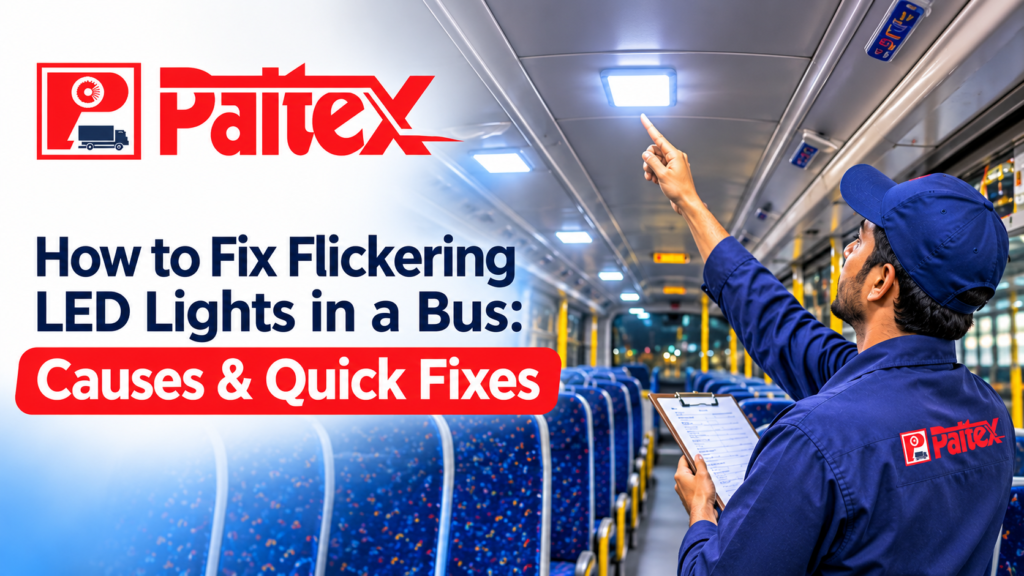
Imagine installing aesthetic LED lights in a bus to improve visibility, lower energy and fuel consumption. Only to find them fluctuating afterwards. It can be annoying and confusing to figure out what went wrong. Flickering lights can happen for many reasons, and not every reason has the same fixes. But remember to choose trustworthy bus LED light manufacturers in India to prevent this from happening. The right manufacturers will ensure quality and after-care service for their products.
Here is what causes flickering LED lights and how to fix them.
Loose Wiring and Vibration Connections
Cause: Buses often experience constant road vibration while running. Over time, this easily shakes loose terminal blocks, ground points, and wire harness connectors. The result is flickering lights that cut out without warnings.
Fix: Check the interior and exterior light fixtures. Tighten every screw terminal, clean corroded grounds, and apply dielectric grease to exposed pins to protect connections from moisture and corrosion. Clean corroded ground points that may disrupt the electrical circuit, and secure the loose wiring harness with zip ties or vibration-resistant connectors to prevent wires from shifting when the bus moves.
Alternator or Voltage Fluctuations
Cause: Bus blower motors, the compressor, and multiple AC units demand a massive amount of power. If the current exceeds the limit, what alternator can supply the charging system is forced to pull out the stored power directly from the batteries. This causes charging system overload, a worn alternator, a failing voltage regulator, or a voltage drop.
Fix: Always use a multimeter to test the bus system voltage while the engine runs. Make sure the multimeter stays steady around 13.8V–14.4V (for 12V systems) or 27.6V–28.8V (for 24V systems). Immediately replace a faulty alternator or install a dedicated voltage stabilizer DC-DC power supply to prevent flickering bus lights.
CAN-Bus or Low-Wattage Load Issues
Cause: This is the most common issue people often ignore. LED lights draw significantly less power than original incandescent or halogen bus lamps. The bus electronic control unit (ECU) or lamp monitoring system may read this low power as a fault. It sends diagnostic pulses that cause the LEDs to flicker or pulse.
Fix: Install parallel load resistors that draw additional electricity and convert it into heat, mimicking the high-power load. Use a CAN bus error-free decoder to smooth out pulses and simulate a normal bulb load, or opt for CAN bus-compatible LED drivers or fixtures.
Faulty or Undersized LED Drivers
Cause: Using cheap or overheated internal and external LED drivers may fail to properly regulate current. LED lights react instantly to small changes in electrical current. Any instability in the driver’s power output immediately converts into visible flashing or strobing.
Fix: Choose reliable Bus LED lights manufacturers in India and replace the defective LED driver or fixture with a high-quality, vibration-resistant, and vehicle-rated unit such as 12V/24V or MIL-STD-compliant.
Conclusion
Flickering LED lights are a common issue that can occur unexpectedly. Learning its causes and quick fixes can save you the cost of an electrician and time. However, it also depends on the manufacturer you choose. Choose the right manufacturer who gives you the highest-quality lights along with aftercare support. This will help you resolve your issue. At Paltex, we are one of the best bus LED light manufacturers in India who design and produce innovative, durable, and high-performance products. With over three decades of experience, we ensure strict quality control processes to ensure better performance, reliability, and long service life.
Frequently Asked Questions
It is generally unsafe to keep driving with flickering LED lights because it either creates a road hazard or signals an underlying electrical failure.
A flickering LED light does not drain the battery. Instead, the underlying electrical fault causing this flickering may drain the battery.
Check the ground wire, power connectors, and fuse first, as these cause 70% of flickering.
Commercial bus LEDs must meet mandatory automotive safety, photometric, and electrical durability certifications: AIS-008, AIS-052, and AIS-010/012 in India (or UNECE / DOT equivalents globally), alongside IP65/IP67 and EMC ratings.
Due to unstable voltage from the bus alternator and battery system LED lights flicker during bus engine idles or accelerates.